Showing posts with label project based learning. Show all posts

Great Educational Ideas from Colleges and the Boy Scouts


cross posted at Tech&Learning Magazine

I went to college at Worcester Polytechnic Institute, WPI, and majored in Aerospace Engineering. I worked for 10 years as an engineer before becoming a physics teacher. WPI has a unique curriculum, called the WPI Plan, consisting of 4 quarters instead of 2 semesters, 3 large projects, and course curriculum that are mainly project based. Each undergraduate has to complete a Humanities Sufficiency Project, and Interactive Qualifying Project (IQP) and a Major Qualifying Project (MQP). The Sufficiency is a 3 credit project and course sequence in the humanities which ensures that all WPI graduates are well rounded. The IQP is a 9 credit project done in the junior year which relates science and technology to society and the MQP is a 9 credit project done in the senior year similar to a Master's thesis. The project based curriculum helps students learn content and develop problem solving, communications, and teamwork skills. It also helps develop ethics and responsibility in the students. I found that my WPI education has prepared me for my career as an engineer, as well as an educator, and served me well in many capacities.

This is the type of plan I try to use with my Physics students. I try to do as many labs, projects, and activities as I can because I know how well that works. The students are more engaged and tend to learn and remember concepts better. Project based learning is been proven to be a great way to educate students. In fact, WPI has done research on this topic. My IQP was on the quality of technical education in the US and we found that the students who did best in STEM (science, technology, engineering, math) majors and careers were the ones who had a good background in high school, including collaborative projects. Other research at WPI has shown the same thing. Many educators and educational institutions also have shown that project based learning is a very effective way to teach and learn STEM topics.

WPI's Mechanical Engineering Department also has a great classroom called the Discovery Classroom. It is a lecture-style room with large tables for the students. It has multimedia capabilities, laptops for the students to use, and a room off to the side which contains equipment for demonstrations. This took a plain lecture hall and turned it into an interactive learning room.

WPI also has some great programs for incoming freshmen to introduce them to the school and STEM topics and help prepare them for the rest of college. High Schools would do well to have similar programs that would help freshmen obtain the skills necessary to be successful in high school.

Other colleges have similar programs that emphasize group projects, the interaction of technology and society and a base in the humanities. High schools have also been moving more and more towards project based learning because it has been proven to work.

K-12 education should take notice of some of the great and innovative things that colleges are doing and adapt them to their own schools. Many colleges have K-12 outreach programs and schools should take advantage of these.

I am also an Eagle Scout, which is the highest rank in the Boy Scouts. I learned a lot in the Boy Scouts besides certain skills in camping, hiking, and the like. I learned how to work as a team, how to be a leader, and how to plan things. In Boy Scouts, the adults are advisors and the scouts do the planning and running of events, training, and campouts. As an Assistant Scoutmaster, I worked with a group of 5 boys who planned and carried out a Camporee for over 500 scouts. The Boy Scouts aren't afraid to let the boys take charge and lead. The adults will step in when necessary, but the boys learn a lot by their mistakes too. The older, more experienced scouts help teach the younger, newer scouts. Discipline is also handled by older scouts and things run very smoothly.

I think schools should do more to let students make decisions and run things. Let the students come up with ideas for lessons, projects, programs and more. Let them lead these projects and have the teachers advise them. The students will learn valuable skills and feel what it is like to take charge of a situation. Have students teach and tutor other students. Have upperclassmen be mentors to the underclassmen.

Some schools already do these things, but others would do well to look outside for ideas for new and innovative programs. Colleges, youth groups, the military, and even business and industry have plenty of great programs and ideas for doing things. Many of them can be brought into K-12 education and can be used to improve student engagement, achievement, and skills building. We have a large number of problems in schools now, and educators have to be creative in coming up with ways to address them. Look to these other organizations for ideas and help. We don't have to do it on our own.

Please share your ideas of things from outside education that could be used inside education.

Resources/more information:http://educationaltechnologyguy.blogspot.com/2009/05/how-to-get-started-with-project-based.html


Free Book - Amazing Web 2.0 Projects


Terry Freedman has put together an excellent, free, book entitled "Amazing Web 2.0 Projects." This book has links, resources, tips, and examples of projects to do with your students using Web 2.0 technologies.

Some of the features of the book:
  • 87 projects.
  • 10 further resources.
  • 52 applications.
  • 94 contributors.
  • The benefits of using Web 2.0 applications.
  • The challenges of using Web 2.0 applications.
  • How the folk who ran these projects handled the issues...
  • ... And what they recommend you do if you run them.
  • What were the learning outcomes?
This is a great resource for any teacher. The projects can be easily modified and there is so much other information and links to help educators come up with their own projects. I recommend this to any teacher, especially teachers who are just starting to use Web 2.0 technologies.

It is available for download, for free, as a pdf file. http://www.ictineducation.org/free-stuff/

PS - my blog is listed in the book as a resource.

HSI - Historical Scene Investigation


Riding the wave of the CSI craze, HSI - Historical Scene Investigation is a ingenious way to teach history. The site was created by a consortium of colleges and the US Library of Congress in is based on Social Studies/History standards.

There are 13 "open cases" for teachers to choose from, with topics such as children in the civil war, the atomic bomb, and the Boston massacre.

Each case poses a question about the topic and has resources for both teachers and students. Students then use the resources on the site to answer the question(s) posed at the beginning of the case.

This is a great resource for teachers to incorporate more project based learning and critical thinking into their classrooms. The site has come up with some great topics and provides excellent resources for the students to use. One of my colleagues who teaches history thought it was great and is using some of cases right now.


Challenge Based Learning


Challenge Based Learning is a resource from Apple that provides resources for teachers to use the "Challenges" in their classroom. The program leverages multimedia resources and "challenges" students to solve a problem working in teams. There is a lot of information and resources available for teachers and you can use their example challenges or create your own.

This is a great resource for teachers who already use Project Based Learning, or who want to start using this type of educational approach. Students learn content, communications, critical thinking and teamwork.

I have already found some great resources and ideas from this site.

If you have used this program, please share your experiences with us.

Krunchd - make one link to multiple sites


Have you ever wanted to share more than one link with someone and didn't want to have to write/type all of the links? Or, are you using Twitter and only have 140 characters available?

Krunchd is a free service that allows you to create one link that will bring someone to a collection of links you set up on Krunchd's system.

Example: I want to share a bunch of article links on Twitter about Project Based Learning. They won't all fit, even by shortening each url. So I go to Krunchd, set up a single link for all of them and post that one link. I can even give the collection a title and description.

You get to pick the URL, which is pretty cool. If you leave it blank, the site will generate one for you. The link will be http://krunchd.com/ and then 18 characters of your choosing.

Original Links:


A very useful site for sharing multiple links.

Should we force students to learn? or How can we change schools to engage students?


As I was walking back to my room today after making some copies in the office, I glanced into some classrooms. I noticed many students and teachers doing some great things and figured there was some good learning going on. But I also noticed that some students had their heads down, or were looking out the window. There were also a few students wandering the halls. It got me thinking, is forcing every student to take certain classes the right thing to do?

(I had also recently read this blog post over at Teachpaperless which got me thinking.)

I was thinking about students that have no desire to learn about Shakespeare, the French Revolution, atomic bonding, or polynomials. I was thinking that many of them may pass these classes and graduate, but not really have gained anything from the class. They may have a poor outlook on education because they were not excited or engaged by their classes. They may feel that school was a waste of time. How many of these students drop out of high school because they hate school? How many dropouts would stay if they could take classes that they WANTED to take? How do we fix these issues?

I am a firm believer that we need more vocational education in our high schools. "Shop classes" and "industrial arts" have been cut and many schools have minimal classes in these areas. I did a summer externship (through the CBIA) two years ago with local manufacturing companies and they all complained that there are not enough machinists and technicians to meet their needs. They were also seeing a shortage of CAD (computer aided design) technicians in the area. Our schools have a limited number of these types of classes, but they are not enough. The state vocational-technical schools are always facing budget issues. We need more.

Many high school students will not go to college, and that is ok. They need to know basics in English, Math, History, and Science, as well as computer basics, to be informed citizens and to be able to function in a workplace. But, do they really need to struggle in upper level classes? Maybe we need to get them to a certain level and then let them pick the classes they want to take. Why do we have to have so many restrictions and requirements?

We should be offering more vocational classes such as machining, CAD, electrician, carpentry, auto mechanics, culinary arts, computer technician and more. This would prepare non-college bound students for good jobs and careers.

We should also take advantage of technology and use it to truly differentiate student learning experiences. Let's get rid of our very old, stagnated system and come up with something new. Like individualized programs for students. With this, we could accommodate more students in the subjects that they really want to learn. Trade/Vocational programs for non-college bound students and more advanced classes for the students who are bored because the work is too easy.

Project Based Learning, online classes, non-traditional sequences of classes, a greater variety of classes, and some outside-of-the-box thinking can help more of our students succeed in life. Online classes and testing could help some students learn the basics and prove proficiency and then allow them to move onto other classes. Imagine what a school like that could look like! All students engaged because they are learning things that they want to learn. Applying all classes to their future needs, whether that is college or job. Authentic learning that truly engages and prepares students for the future.

I would love to teach in that school.

I'd love to hear your thoughts on this.

UPDATE:
There are some very similar discussions going on in right now. Check out these articles too:
and

Check them all out and join the discussion.

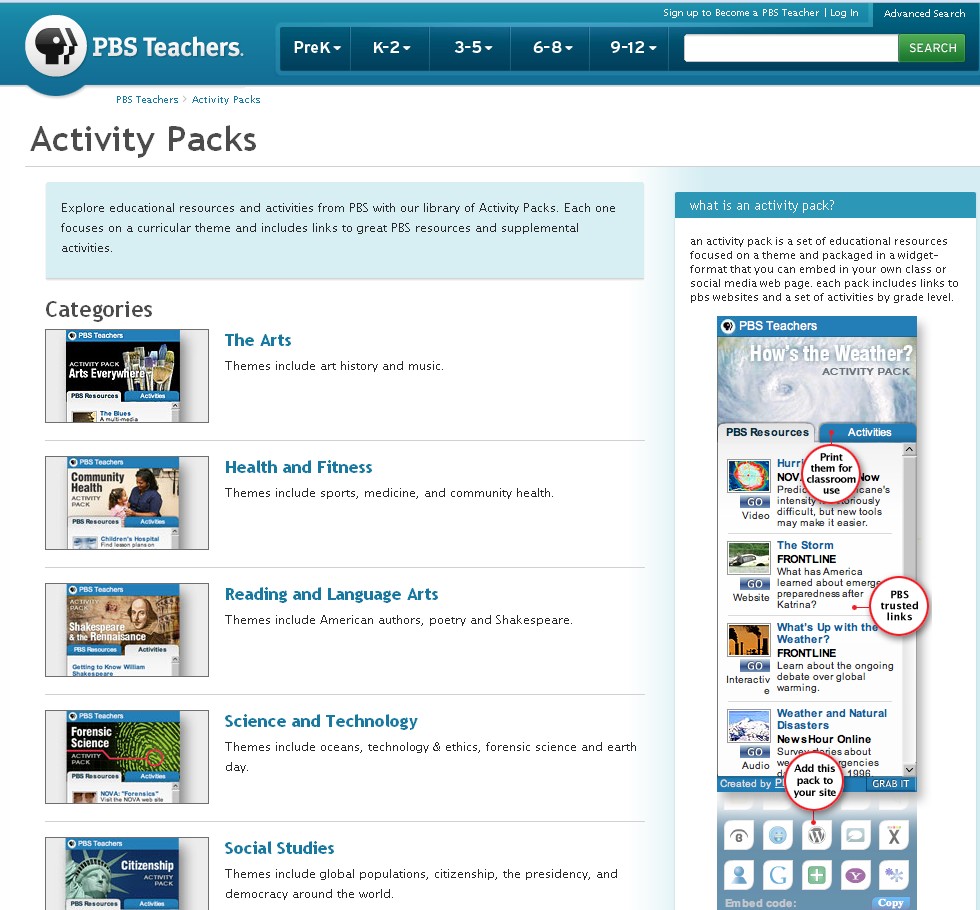
PBS Teachers Activity Packs


PBS Teachers has some great activity packs for teachers to use with their classes.

They have packs in arts, health and fitness, reading and language arts, science and technology, and social studies.

The activity packs have PBS resources, such as videos of PBS shows like NOVA, web links, and lesson plans for each topic. There are activities for different grade levels also.

These packs are great ways to have a multimedia, project based lesson for your class.


Edheads - online projects


Edheads is a great web site that has online projects for students to do. These projects help students explore and learn about a variety of topics.

Some of the projects include - design a cell phone, virtual knee surgery, simple machines, and more.

I found it fun also! Try it out yourself and you will find that it is a nice resource to use in your classroom. The crash scene project was fun and is great for a physics class.


Disney Planet Challenge


Disney has a great, free, contest for students in grades 4-6 in the United States. Disney's Planet Challenge is a project based environmental competition that helps students learn about science, conservation and teamwork.

The friendly competition has ready made curriculum and lesson resources and the site is very easy to use and navigate. Everything you need to know is on the site. Curriculum and contest resources are also available for download in PDF form.

The curriculum and resources were designed by scientists and educators. You can tell that teachers had a hand in the development because of the way things are written and set up. It is very easy to implement.

There are some really great prizes (grants!! $$$) and the grand prize is grant money, NSTA membership and conference attendance, prize packs for the students, and an all expense paid trip to the Disneyland Resort for the teacher, principal, students, and chaperone's. Not bad for a free contest.

Eligibility is 4th, 5th, or 6th graders, or a combination, in a class or club in the USA. 40 students maximum in the class or club.'

While the contest is only open to grades 4-6, teachers of other grades could use the materials as a guide for their own projects.

Deadline to enroll is Friday, December 18th 2009 at 1200am PST. (I'd make sure I have the enrollment done a few days before that).

All project portfolio's are due by February 26th, 2010. Winners will be announced in April 2010.

Check it out and Good Luck!!


21st Century Skills


(cross posted at http://www.techlearning.com/blogs/23342)

"21st Century Skills" is an often used phrase to describe the skills that educators and employers feel that students need to learn in order to be successful in school, careers, and life. I've argued that many of those skills have been needed and taught for decades.

If you think about it, students have always needed to be able to communicate, work in teams, follow directions, solve problems, and find information. I was taught these skills in high school and college and I was doing projects back then also. I graduated high school in 1988 and college in 1992. 21st Century Skills and Project Based Learning are not new ideas. The difference is that these skills need to be applied using new technology.

I was in college when the internet was young. We had text based FTP, email, and newsgroups. In my first engineering job, we started to use the internet for research and communication. Today, everything can be done using the internet and anything and everything can be found on the internet. When I was in school, we had encyclopedias and other reference books that were considered acceptable, reliable and peer reviewed. Today, we have the internet with information published by anyone. This means that today's students need to know how to find the information they are looking for and analyze it to see if it is reliable.

When I was in school, we had to go to the library, or hope our textbook or the encyclopedia at home had the information we needed. Today, students can find information on the internet from home, school, or anywhere using WiFi and even their phones.

This instant access to information means that students don't have to memorize as much information to get things done. They have to know how to find it and analyze it to see if it is reliable or not. We should be teaching them this. Instead of content memorization, we should be teaching content processes.

I feel that critical thinking, problem solving, communications, and teamwork are not 21st Century Skills. They are critical skills that humans have needed throughout our history. I would say that 21st Century Skills would include finding and analyzing data on the internet and using new technologies to do things better and more efficiently.

To do this, we should incorporate projects in our curriculum that require students to use technology to complete the project. We need to go beyond just web research and PowerPoint and have students create and interact. Blogs, web sites, online discussions, videos, and more can all be used in a project. The project then teaches the critical skills mentioned above, as well as the 21st Century Skills.

Projects should be based on real life issues, not just a topic from class turned into a project. To get ideas, look in the newspaper and news stories, as well as hot topics online. You can also talk to local businesses about issues that they are working on. You can even ask the students if there are issues or projects that they would like to work on. Be creative.

Educators need to teach content, critical skills, and how to use technology to find information, solve problems, and achieve goals. Projects are a great way to do this.

For more information on 21st Century Skills and Project Based Learning:
and search this blog.

End of the year fun / madness?

(cross posted at Tech&Learning magazine)

As the end of the school year approaches, we, as teachers, have a lot of things to deal with. I can only speak about high school, but I'm sure the middle and lower grades have similar issues.

At the high schools we first have the issue of AP Exams at the beginning of May. Once the exams are done, many AP Students feel that they are done for the year. As an AP Physics teacher, I keep them engaged and learning for the rest of the year with fun projects. They start with a web quest about rockets and then build and launch their own model rockets. They love it! Then, they do a web quest on aerodynamics and then design, build, and fly their own gliders. They learn some great physics topics while having a lot of fun.

The next issue we run into is prom season. Prom's and Ring Dances equal early dismissals on those days for the students attending (need to do hair, makeup, tux, limo, etc.). On these days, I do fun learning activities with the students that are here. The activities are web based, which they enjoy. But this also means that I can have the absentee students make up the assignment on their own later.

I teach 90% seniors. Senior skip day is another day where I have some students and I do the same thing as the prom day.

Then the inevitable end of the year assemblies, parties, and events start interfering with class time. I have learned to finish the majority of the material by AP Testing time so that I'm not pulling out my hair with all the interruptions to class time at the end of May and beginning of June.

My class plan for May and June is all projects. In this way, class interruptions and absences don't really affect the class. Students can work on the projects on their own when they miss class, and the rest of the students are engaged. They very quickly get senioritis and can not, and will not, sit for very long. Group projects keep them learning and engaged while allowing them the socialization and change in pace that they all want.

Another nice part of projects is the fact that they give the teacher more time to mingle with the students during the day and really get a feel for how the class went and how much the students have learned. It is also easier than correcting problem sets or essays!

I use web quests, videos from Discovery Streaming, and projects to keep my students learning during a time of distraction. Think of projects related to your curriculum that would be great to do at the end of the year and use that instead of lectures, problem sets, or standard labs.

The rockets project is my favorite and my students favorite. The web quest incorporates elements from NASA's web site. The students are applying multiple areas of physics during this project: energy, chemical reactions, fluid dynamics, forces, Newton's Laws, and more. They get to work in a group and do something hands-on and creative (they get to decorate the rockets any way they want and they are also able to do different fin designs). The best part is launch day. The students get to go outside and launch rockets. I handle the actual launching so that I can ensure safety, but the students love the countdown and watching the launch. They also have to chase down rockets that drift in the wind. Who wouldn't want to be outside launching rockets on a beautiful Spring day?

Rockets resources:
NASA's Beginners Guide to Rockets: http://www.grc.nasa.gov/WWW/K-12/rocket/index.html
Estes Model Rockets - Educator Page: http://www.esteseducator.com/
Apogee Rockets - http://www.apogeerockets.com/ (click on "Educational")
National Association of Rocketry: http://www.nar.org/teacher.html

I also use a music video to get them inspired for the rockets project - "Countdown" by Rush. The video is on YouTube and you can find the lyrics on line on a variety of web sites.

The song was written after the band attended a Shuttle launch in the 80's. The song and video are very powerful and really show the excitement and achievement of the space program.

Many of the science teachers in my school also use projects at the end of the school year and do many of them outside. Next year, we are thinking of doing a science field day outside in May, and have a cookout for lunch. I am working on some ideas for projects now. For physics, I was thinking of the rockets, catapults, bridges, mousetrap cars, and boats.

The end of the school year has many distractions for students and teachers need to be creative in how they keep students learning and engaged during this crazy time.


How to Get Started with Project Based Learning


(image from education-world.com)

Originally posted on TechLearning magazine.

Project Based Learning (PBL) is a great way to teach students content, 21st century skills, and engage them in something fun and educational. I spoke more about PBL in an earlier blog (http://www.techlearning.com/blogs_ektid17052.aspx ) and we had some great reader comments (Tech&Learning, May 2009, page 14). Today I'd like to give some tips and ideas on how to get started with PBL in your classroom.

First of all, PBL can be used in any classroom, in any subject, at any grade level. Projects can be one class period, or take weeks to complete. Projects can address one curriculum item, or many. It all depends on how you want to implement it and how comfortable it is for you.

PBL does take planning. You need to look at your curriculum and the objectives you want to accomplish and then plan a project that will lead your students to reach these objectives.

For instance, I teach physics and developed a project for my classes on structures and stress and strain. The project started with a very short lecture on the topics of stress and strain and the physics behind it. Then the students completed a webQuest about stress and strain that lead them to information about bridges and bridge design. From here, they used bridge design software from West Point to design a bridge that would meet certain requirements I set up. The final step was to build a model of their bridge and see if it would hold the weight. Each group was competing to see who's bridge would hold the most weight. During this project, students learned about stress and strain, structures, applications of physics to real life, web searching, team work, communications, design, and model building.

Another example of PBL is having the students research a topic and present it to the rest of the class through a multimedia presentation, website, or poster. Each topic should be an extension of something you just did in class. In this way, the students teach each other. They will also learn their topic more in depth when they have to be able to explain it to others.

Start small. Think of a lesson you teach and think of a way that the students could do a project to learn that topic instead of sitting in class listening to you talk about it. Try out a one class period project before moving on to a large scale project. Search the internet for examples of projects and adapt them for your class. An internet search of "Project Based Learning" will get a huge list of results for you. I also suggest searching for "WebQuests", "Problem based learning" and "Projects" with your classes subject and grade.

Another idea for projects is to look at your school or community and see what they need. Art students could research the history of the school and create a wall mural. English students could write a history of the school, or help other groups write letters to lawmakers to get an issue addressed. Music students could write an updated version of the school song, or even a new one. Tech Ed students could build wheelchair ramps, furniture, or other items needed in the community. Biology students could study water quality in a stream nearby or research animal or plant life.

An idea I got from my wife (a Biology Education student) is to have students create a lesson for other students about a topic. I am planning on using this with my AP Physics students after AP testing this month. They are going to create a physics help guide for the honors physics class. Next year, I'm going to have the honors physics class create a help guide for the general physics class. The students will learn their content better and provide a great resource for fellow students.

PBL offers teachers a new way to have their students learn content as well as 21st century skills. The students can have fun while learning, and even provide a service for others as part of the project. Be creative and have fun with PBL.
Some web resources to get you started:
Project Based Learning online - http://pbl-online.org/

Please share your project ideas with everyone!


Project Based Learning

Project Based Learning - a relatively new idea in high school education, but something I was exposed to many years ago (21) as a freshman at Worcester Polytechnic Institute (WPI). I received my Bachelor's Degree in Aerospace Engineering in 1992 and my education at WPI has served me well in a variety of capacities. WPI is mainly a science, technology, engineering, and math school, with some other majors mixed in. 

WPI has a unique learning system, called the WPI Plan. This plan stresses project based learning. Why? Because back when they developed the Plan (over 30 years ago) they knew that the only way to truly master subject area content is to apply it. They also knew that students needed to develop teamwork, communication skills, problem solving skills, creativity, critical thinking, and research skills (sounds like "21st Century skills" doesn't it?). 

The projects are an integral part of the Plan. All classes are expected to use projects in their curriculum and the school has three projects that all students must complete. The Humanities Sufficiency is a set of 5 themed humanities courses followed by a 1 course long independent study. This project is meant to make the student more well rounded. The IQP (Interactive Qualifying Project) is a team project studying the effects of technology on society or using technology to benefit society that is equivalent to 9 credits. The MQP (Major Qualifying Project) is also equivalent to 9 credits and is a major project in your subject area, similar to a senior thesis.

I think that WPI was ahead of the game with their plan, considering this is the route that high schools and even middle schools are going. K-12 education is starting to realize how important these skills are and that project based learning is a great way to engage students while teaching them content and other needed skills.

I try to use projects when ever possible in my classes. I found that my WPI education has taught me more than the STEM subjects, it has taught me valuable skills that have allowed me to be successful as a teacher, paramedic, engineer, manager, consultant, and husband. I would love to see high schools implement a more structured project based curriculum and provide more support for teachers. I think many teachers are afraid of projects because they fear that the students will not get all of the content that they need. However, if the project is structured properly, the students will get the content in order to complete the project. They will get the content, develop teamwork, communication skills, problem solving skills, and learn organization. They will also get to be social with other students which is very important to them.

Technology can help with project based learning. I always wonder what we could have achieved back then if we had the World Wide Web as it is now. All we had was email and some ftp sites. Students can use technology to do research, organize their projects, and then present their projects as presentations, web sites, blogs, or videos. 

For more information on project based learning, see WPI, Edutopia, PBL, or Google it.